Tag: custom soft lenses

Comfortable Customizing

[us_post_title]
[us_post_date]

The Future of Specialty Lenses

By Eef van der Worp

Comfortable Customizing

Never a dull moment in our industry. Although this past period will surely be remembered as ‘the COVID era’, there are so many new and exciting developments going on that maybe in the future, all of these technological advances may outweigh the negative vibes of COVID for our industry.

Customizing for Myopia

By far, the most potential in our field is in ‘upgrading’ myopia correction efficacy. Historically, we have always used standard ortho-k lens designs. But we can do better than that, it seems, and it has become increasingly obvious that with so many variables, it is hard to even get started on that without being dazzled. Let me try, though.­

The optics of the eye are more complex than many of us realise. For one, the aberrations of the eye change with age. Young children, kids in elementary school and young teens all have different aberration patterns. The higher-order optics of the eye change with pupil size too. Taking all of that into account can surely enhance and optimize the orthokeratology outcome. But it gets even more exciting if we go for the ‘full business class upgrade’ by measuring and applying individual aberration patterns. Everybody is different, and in fact, every eye is different. Understanding this and incorporating it into an individual lens for a specific patient may prove to be very efficacious.

A fascinating review paper by Rohan Huges and the research team at Queensland University of Technology in Brisbane (AU) states that HOAs are optical imperfections of the eye that alter retinal image quality despite optimal correction of spherical defocus and astigmatism. Because HOAs reduce retinal image quality and produce variations in optical vergence across the entrance pupil of the eye, they may provide optical signals that contribute to the regulation and modulation of eye growth and refractive error development. The magnitude and type of HOAs vary with age and refractive error and during near work and accommodation. Furthermore, distinctive changes in HOAs occur with various correction modalities, including, near addition spectacle lenses, ortho-k and soft multifocal and dual-focus contact lenses. In other words, there is work to do, but there surely is potential.

Customizing Corneals & Sclerals

If we look just at what eye care practitioners (ECPs) in my country (the Netherlands) do: by far, the majority of corneal GP lenses are not fitted with a trial set anymore. Sometimes it is still nice to have a trial lens available, to get a quick idea of the potential gain in visual acuity (especially on more challenging corneas). But from a fitting process point of view, the algorithms that the large manufacturers use to generate a lens based on corneal topography are so advanced, that only a very seasoned and experienced lens fitter with a lifetime of practical years under his or her belt could match that. But even then, it may be hard to beat the algorithm, let alone for a new ECP just coming out of school. This is a good thing: it means we are not fully reliant on the human factor anymore to fit corneal GPs going forward.

The advancement that scleral lens back surface designs have made in the last year or so has been amazing to watch. Early studies at Pacific University (US) already noted that the scleral surface on the anterior eye isn’t spherical at all – and that it increases in irregularity further out to the periphery. But now with two state-of-the-art profilometry instruments and the latest Scheimpflug instrument upgraded to measure scleral shape, toric and more complex scleral lens designs are now becoming the standard. 

There are various ways to fit these: you can use the scleral topography data to design the rotationally asymmetric scleral lens yourself using software, you can have the instrument with the incorporated software do the trick, or you could send the scleral topography file to the manufacturer to be processed and transformed into a lens – or a combination of the above. In addition, there is the impression-moulding technique for sclerals as the ultimate customized solution, if needed. All of this means, as with corneal GPs, that customization is becoming the norm with scleral lens designs.

Customizing Soft

Of all the specialty lenses, soft customized lenses may actually have the biggest potential. For starters: the bulk of all contact lenses fitted internationally are soft lenses – 86% according to the latest Eurolens Research Survey data. And – funny enough – we don’t fully understand this modality. 

Recent studies have shown what the normal eye looks like over a larger diameter (covering the area where a soft lens lands), while at the same time, more information about the overall sagittal height of the lenses that we fit daily has become available. Work by Graeme Young et al confirmed that soft lenses need to be fitted ‘somewhat steeper’ than the ocular surface in order to gain the desired ‘grip’ on the eye. In our terminology, we call this the δ-sag (delta-sag): the difference between the sagittal height of the ocular surface over a given area and the contact lens sagittal height, so the lens needs to bend or deflect to do so. 

This finally gives us more control over actually ‘fitting’ soft lenses again. But it also shows that any given soft lens on the eye has to bend or flex, to conform to the shape of the eye. The term used for this is the deflection factor. How much exactly is still up for debate, and in current lens wearers, this value varies quite a lot. This also means that the deflection in some lenses may be 100 microns, while in others it could be several hundreds of microns. What does that do to the optics of a lens? We don’t know that. In a standard -3.00D spherical lens design, it probably will not generate more than 0.25D change. But in more complex lens designs – e.g., toric or multifocal, this could prove to be more than trivial.

Understanding this, and then applying that to soft lenses – taking the individual and general characteristics regarding age and pupil size into account – could potentially have a huge impact. 

Educational Series & the Future

The educational grant over 2021, kindly supported by Contamac, has allowed me to provide generic specialty lens education for a better understanding of what we are actually doing with all these different specialty lens modalities and to potentially take advantage of all of the possibilities available to us.

Topics over the past year included mostly scleral lenses, corneal topography, scleral topography, soft lens fitting and myopia management. But what all of these have in common is the generalised potential to customize lenses and to take (more) advantage of the individual needs of the patient – whatever they may be.

The future looks bright for specialty lenses in my view. We just have to get a little bit more comfortable with customizing. I think we ‘get it’ now as an industry to a large degree when it comes to aligning the lens with the eye and respecting the ocular surface with various lens modalities. ‘Next up’ is understanding and applying optimal and advanced contact lens optics. Stay tuned. Even 3D printing options are being explored seriously now.

Thank you to Eef van der Worp for contributing to Global Insight.

[us_separator size=”small” show_line=”1″]
References:
Alam et al – 3D Printed Contact Lenses – ACS Biomaterial Sci Eng  – July 2021

Hughes et al – Higher order aberrations, refractive error development and myopia control: a review – Clin Exp Optom – January 2020
Janssen F – Size does matter – Contact Lens Inside (Dutch Contact Lens association contact lens magazine) – December 2021
Morgan P et al – International Contact Lens Prescribing 2021 – Contact Lens Spectrum – January 2022
Tomiyama et al Greater higher order aberrations induced by toric orthokeratology versus soft toric multifocal contact lens wear – Ophthalmic & Physiological Optics – June 2021
Van der Worp – Variation in sag values in daily disposable, reusable and toric soft contact lenses in the journal – Contact Lens and Anterior Eye – December 2021


[us_separator size=”small” show_line=”1″]
[us_image has_ratio=”1″ image=”9904″ size=”us_600_600_crop” ratio=”3×4″]

Eef van der Worp is an educator and researcher. He received his optometry degree from the Hogeschool van Utrecht in the Netherlands (NL) and has served as a head of the contact lens department at the school for over eight years. Eef received his PhD from the University of Maastricht (NL) in 2008. He now runs his own research & education consultancy ‘Eye-Contact-Lens’ which is based in Amsterdam (NL). He is a fellow of the AAO, BCLA and the SLS, a lifetime fellow of IACLE and an honorary life member of ANVC. He is on the education committee for the GSLS and the OVN.  Eef is adjunct assistant Professor at Pacific University College of Optometry (Oregon, USA), and adjunct Professor at the University of Montreal University College of Optometry (CA) and he is lecturing extensively worldwide and is a guest lecturer at a number of Universities in the US and Europe.

[us_separator size=”small” show_line=”1″][us_separator size=”small”]
[us_post_navigation in_same_term=”1″]
[us_sharing providers=”facebook,twitter,linkedin” align=”right”]
Tags: , , , , ,

Backtracking From Scleral Lenses: When Custom Soft Lenses Get the Job Done

[us_post_title][us_post_date]

by Priya Patel, OD.

Introduction

Scleral lenses provide significant visual and therapeutic advantages for patients suffering from a variety of corneal conditions: inclusive of kerato-ectasias, penetrating keratoplasties, and varying severities of corneal irregularities.

This advancement in the specialty lens realm has expanded to the use of sclerals, yet previous technologies are still capable of providing comparable comfort and vision. 

Custom soft lenses have potential to significantly improve vision without the need for complex designs, and small diameter gas permeable lenses can achieve similar visual outcomes as sclerals at a fraction of the cost. Custom soft lenses can be entirely customizable from base curve, diameter, power, to even center thickness to improve upon masking corneal irregularities. Often in clinical practice, there exist simpler solutions to complex problems.

Case Report

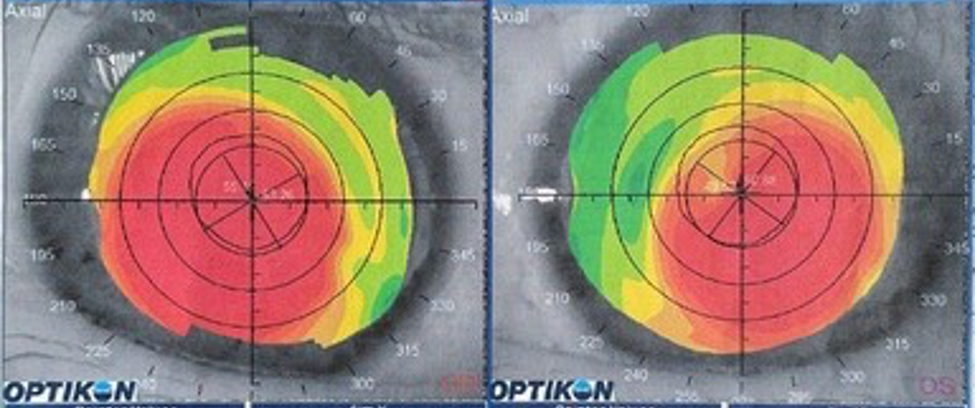
A 46-year-old White male teacher with a history of keratoconus OD>OS presents to our office seeking scleral lenses. Patient JB has a history of gas permeable (GP) lens intolerance and has successfully avoided PKP (penetrating keratoplasties) in both eyes. The continuous irritation in his GP lenses and the fear they can pop out at any moment, has him seeking out scleral lenses.

His corneal shape shows most significant steepening directly over the visual axis, which would be well vaulted by a prolate design. Utilizing the Zenlens (Alden) Prolate fitting set, JB was fit into a 16.0 diameter scleral lens in both eyes, achieving BCVA 20/25 OD/OS. The initial fitting period was completed without any significant complications, and JB was happy to have clear, comfortable vision. At the one year mark after his initial scleral lens fitting, JB started to develop significant redness after 4 hours of lens wear with concurrent fogging, which only resolved after reinsertion of his lenses. After lens removal, the chronic irritation persisted. This led to intolerance of his lenses.

Zenlens Prolate
Scleral Lens
Right Eye Left Eye
SAG/Base Curve/Diameter (μ/mm/mm) 4950/6.70/16.0 4950/6.70/16.0
Power -4.75-2.00×150 -6.25-1.25×070
Limbal Clearance Curve (LCC) +60 STD
Advanced Peripheral System H = 7 steps flat
V = STD
2 steps flat
Visual Acuity 20/25 20/25

JB became more frustrated, and he pleaded for any lens option, which would yield a similar visual outcome, but improve his comfort. We were sceptical we would be able to achieve this, but in an effort to exhaust all options available,  we switched him into a custom soft lens modality in both eyes.  To optimize comfort and reduce the chance of redness, fogging, irritation after lens removal as JB previously experienced, he is fit into the NovaKone Toric OD and Biofinity XR Toric OS. The custom soft lens selection was based on the poor BCVA (20/80+) attainable through refraction: the customizable center thickness of the Novakone lens would allow greater control in neutralizing irregular astigmatism in the right eye. The left eye was correctable to an adequate level (20/25+) with glasses so a monthly disposable lens had potential to correct JB to a level at which he would be functional. 

Custom Soft Lenses

K Values:

OD: 55.15@121/53.26@031

OS: 50.88@053/49.52@143

Custom Soft Lenses

OD: Novakone Toric lens, rotated 15 degrees temporally (markings are highlighted with yellow dashes).
OS: Biofinity XR Toric lens, showing no rotation (lens marking is highlighted with a yellow dash).

 
Refraction  
OD -12.75-1.75×025      20/80+
OS -0.50-4.00×145       20/25+
Custom Soft Lens Right Eye Left Eye
Name Novakone Toric Biofinity Toric XR
Base Curve/
Diameter (mm)
7.8/8.4 IT=2 8.7/14.5
Power -7.00-0.75×020 -2.00-2.75×160
Visual Acuity 20/20- 20/20-2

These changes in lens modality improved his contact lens wearing experience and significantly simplified his daily lens wear routine. He has been in his new lenses for over a year with no degeneration in vision, and no recurrences of discomfort or irritation.

Discussion

Scleral lenses are a mainstay as a rehabilitative and therapeutic contact lens option, but alternatives exist for patients from mild to advanced cases of corneal irregularities. Taking into account comfort, lens handling capabilities, alternative specialty lens considerations can lead to improved outcomes as demonstrated in this case.

Scleral lenses require hand steadiness, ability for full control of fine motor skills, and neck mobility. Patients suffering from tremors, neck pain, or mobility issues often have trouble inserting scleral lenses on their own, but have minimal issues with soft and GP lenses. Improper insertion of scleral lenses can lead to air bubbles, and discomfort with lens wear. On the contrary,  minimal risk is associated with difficulties with soft lens insertion .¹

Scleral lenses are associated with an increased risk of hypoxia if the tear film layer between the corneal surface and the back surface of the lens exceeds 200nm.²?³ Soft and GP lens lenses pose a lower risk for creating a hypoxic environment even for fragile corneas.

Utilizing higher modulus soft lenses allow some masking of irregular astigmatism for better visual outcomes. Although in this case, since JB achieved adequate vision through a refraction  in his left eye, we were able to fit him in a lower modulus standard soft disposable lens. If he experienced difficulties with the quality of his vision in the left eye, a higher modulus monthly disposable lens would be his next option. His right eye, however, warranted a lens with a greater center thickness to mask his irregular astigmatism. Custom soft lenses are entirely customizable, inclusive of increasing the central thickness to enhance the masking of any irregularities.⁴

Scleral lenses will often be a superior lens for patients suffering from contact lens discomfort due to lens intolerance (without underlying dry eye disease). As they remain steady on the ocular surface, the optics can be decentered to allow for improved correction of higher order aberrations versus a soft lens or a GP lens.⁶

Conclusion

Soft contact lenses and gas permeable lenses are viable options for therapeutic lens correction. Scleral lenses can be considered an excellent choice as a troubleshooting lens, but it cannot be the only option available for patients who are seeking a specialty contact lens solution. When presented with a patient who is not comfortable in their scleral lenses, often a creative solution is warranted to find an alternative solution.


1. Fadel D, Toabe M. Scleral Lens Issues and Complications Related to Handling, Care and Compliance. JCLRS [Internet]. 2018Oct.26 [cited 2021Jan.13];2(2):e1-e13. Available from: http://www.jclrs.org/index.php/JCLRS/article/view/24
2. Compañ V, Oliveira C, Aguilella-Arzo M, Mollá S, Peixoto-de-Matos SC, González-Méijome JM. Oxygen diffusion and edema with modern scleral rigid gas permeable contact lenses. Invest Ophthalmol Vis Sci. 2014 Sep 4;55(10):6421-9. doi: 10.1167/iovs.14-14038. PMID: 25190661.
3. Michaud L, Vincent S. SCLERAL LENSES AND HYPOXIA: A BALANCED APPROACH. https://www.clspectrum.com/issues/2019/october-2019/scleral-lenses-and-hypoxia-a-balanced-approach. Published 2019.
4. Şengör T, Aydın Kurna S. Update on Contact Lens Treatment of Keratoconus. Turk J Ophthalmol. 2020;50(4):234-244. doi:10.4274/tjo.galenos.2020.70481.
5. Downie, L. E., and Lindsay, R. G. (2015), Contact lens management of keratoconus. Clin Exp Optom, 98, 299– 311. doi: 10.1111/cxo.12300.
6. Waleed Ali Abou Samra, Amani E. Badawi, Hanem Kishk, Ayman Abd El ghafar, Mohamed M. Elwan, Hossam Youssef Abouelkheir, “Fitting Tips and Visual Rehabilitation of Irregular Cornea with a New Design of Corneoscleral Contact Lens: Objective and Subjective Evaluation”, Journal of Ophthalmology, vol. 2018, Article ID 3923170, 8 pages, 2018. https://doi.org/10.1155/2018/3923170

Thank you to Dr Priya Patel for contributing to Global Insight.

[us_separator size=”small” show_line=”1″]
[us_image image=”9323″]
[us_separator]

Dr. Priya Patel received her Doctorate of Optometry from SUNY. She joined the premier practice in NYC and Long Island: Farkas, Kassalow, Resnick and Associates upon graduation, where she focuses clinically on speciality contact lens fittings. Dr. Patel routinely helps patients with keratoconus and other corneal disorders, as well as managing progressive nearsightedness with contact lenses (myopia management).  She also designs and prescribes custom contact lenses such as scleral lenses, hybrid lenses, and multifocal lenses. Dr. Patel has authored articles in the area of specialty contact lenses, and hosted workshops on practice management related to specialty lenses. She is currently residing in London.

[us_separator show_line=”1″ size=”small”]
[us_post_navigation in_same_term=”1″]
[us_sharing providers=”facebook,twitter,linkedin” align=”right”]
Tags: ,