Contamac, the world’s largest independent supplier of contact and intraocular lens materials, with a global reputation for developing creative and innovative products, services and solutions, has been awarded a second Queen’s Award for Enterprise, this time in the Innovation category.
Following on from the Queen’s Award for International Trade in 2012, this second award recognises Contamac’s Definitive range of latheable silicone hydrogel materials, the first range of silicone hydrogel contact lens materials for the speciality contact lens industry.
Commenting on the award, Robert McGregor, Managing Director of Contamac, said: “We are delighted to have been honoured with this prestigious award not once, but twice. Innovation is what drives this company and is paramount to our success. We are committed to support the laboratory network and aim to provide innovations, which will continue to give the speciality contact lens industry a competitive edge.”
Last year the company completed the move to its new and fully purpose built headquarters in Saffron Walden. The new facilities offer 250% more space to Contamac’s R&D team and are furnished with state of the art equipment. Robert McGregor added: “Our new facilities will further support our R&D efforts going forward. I am pleased the team here at Contamac have been recognised as being at the forefront of R&D.”
The Queen’s Awards are the UK’s most prestigious business accolades and are awarded to businesses which have shown outstanding achievement in innovation, international trade and sustainable development. The awards are the highest official UK awards for British businesses and are awarded by Her Majesty The Queen on recommendation from the Prime Minister.
Since it was founded nearly 29 years ago, Contamac has prided itself upon being a partner to the speciality contact lens industry. At the recent Global Speciality Lens Symposium held in Las Vegas in January, the Managing Director of Contamac, Rob McGregor, stressed that the company’s core values have remained unchanged and that going forward, Contamac would remain a trusted partner to the industry. He also said that Contamac’s commitment to developing new, innovative products through a long term R&D programme remains at the heart of the company’s business strategy.
This meeting has grown year on year to become a hub for practitioners from the U.S. and International markets to meet, socialize and exchange ideas with colleagues and laboratories alike. More than 680 vision care professionals came from all around the world to focus on advancements in specialty contact lens fitting. Top U.S. and International speakers ensured that the quality of CE accredited lectures, presentations, panel discussions was of the highest calibre.
Changes in the dynamics of the market this year created a buzz in the hallways and lecture rooms as practitioners and laboratories speculated upon the possible ramifications that the new order would bring. Contamac were present in numbers, and Rob McGregor’s message from the podium ensured that all members of the team were kept busy over the course of the meeting with customers new and existing eager to discuss how recent events were likely to affect their businesses.
Scleral lenses and Ortho-k continued to dominate interest in both lectures and at the exhibition. The use of large diameter and scleral designs, once a very specialised area and fitted by a select few practitioners has expanded to include dry eye and astigmatic patients, with some advocating their use as an alternative to regular GP lenses. Most labs now have a scleral design and many had toric and multifocal designs to offer.
Year on year, this meeting is growing in importance for the speciality lens market, and with the growing number of international visitors is living up to its name as a truly global meeting.
Contamac Booth at the GSLS 2016Martin Conway presenting at the GSLSDinner in Las Vegas with X-Cel Contacts
The superb range of Contamac IOL materials is the result of years of in-house Research & Development, but the company also takes care to verify its research with independent laboratories. In 2013 Contamac started collaborating with the world-famous Apple Lab in Heidelberg, Germany. In this edition of Global Insight we profile the prestigious centre of IOL research.
David J. Apple (1941–2011) is affectionately remembered as the official biographer of Sir Harold Ridley, the inventor of the intraocular lens (IOL). As an ophthalmic pathologist, Apple pioneered research into the pathology of IOL complications and became an expert in ocular pathology, cataract surgery, IOL implantation and refractive surgery.
In his later years he was seriously ill and recognised that his age and illness did not leave him much time to conclude his work. He worried about who would continue with it, who would take the relay baton? He wanted to “get back to basics” and provide information and advice to surgeons which he had begun years previously, by reinstituting the study of autopsy eyes. He was concerned that many new lenses and other devices were implanted with no independent research and little oversight. He was distrustful of the marketing of fashionable premium IOLs that appeared to have unfounded claims. It seemed to him that many new lenses and biomaterials came on the market without real proof of safety and efficacy. He had shown throughout the years that careful examination of autopsy eyes could reveal a truth about how the implant works. He would say “These findings do not lie and cannot be spun”.
Over thirty years of IOL Material research
In the early 1980s David Apple had just started working as a general ocular pathologist, when one of the first specimens he received was an enucleated eye. It contained an early J-loop Posterior Chamber IOL. Prior to explantation the eye had become blind because of IOL-related complications. The specimen was labeled IOL No. 1 and it marked a starting point in the field of IOL pathology.
A report on IOL No. 1 was submitted to the Ophthalmology Journal. Given the usual waiting list for papers to be published, Apple was surprised when the editors promptly accepted his one. He learned later that they did so because they were strongly anti-IOL, as were many in the ophthalmic establishment at this time. The editors hoped the paper might signal the beginning of the end for IOLs.
But surgeons read the account with interest. The results were helpful to them in recognising the pathology of IOL complications. In the first 30 years after Ridley invented the implant, there was a poor uptake in using IOLs, as surgeons would struggle to achieve good results when inserting lenses through large-incisions, without the instruments, lighting and microscopes that we have today. But the main reason for the delay in the use of IOLs was the antagonism held by many eye surgeons toward Ridley and his “radical” new invention. The prevailing dogma was that it was dangerous to implant a “foreign body” permanently into the eye.
Today cataract surgery with IOL implantation is a very successful procedure. Advances in the use and application of new instrumentation, operating microscopes and phacoemulsification, contributed to this success, but so did the work of David Apple and his colleagues. His research focused on avoiding complications by improving IOL design and the choice of materials. At the start of the 1980s materials such as Nylon and Polypropylene were used to make IOL haptics because they were very flexible – something the surgeon desired for manipulating a lens within the confines of the eye. However the autopsy eyes with these lenses told a different story – the materials had poor “memory”. The lens lost its shape once implanted and moved inside the eye. The pathology results correlated well with the medical history, patients’ symptoms of perceptible lens decentration, inflammation and other complications. Clearly what was advantageous to the surgeon at the time of surgery (flexible haptics) was over time, likely to be a danger to the patient. The industry listened to Apple and by the end of the decade most lenses were made as single-piece PMMA lenses – lathe-cut or moulded from one piece of PMMA a material which had better “memory” over time once in the eye.
Today the Apple Lab remains an official Collaborating Center of the World Health Organisation’s Prevention of Blindness Programme. David Apple’s meeting in 1990 with the WHO, eventually proved instrumental in providing information to them on the best type of IOL to be used in cataract surgery in developing countries
Training and Education
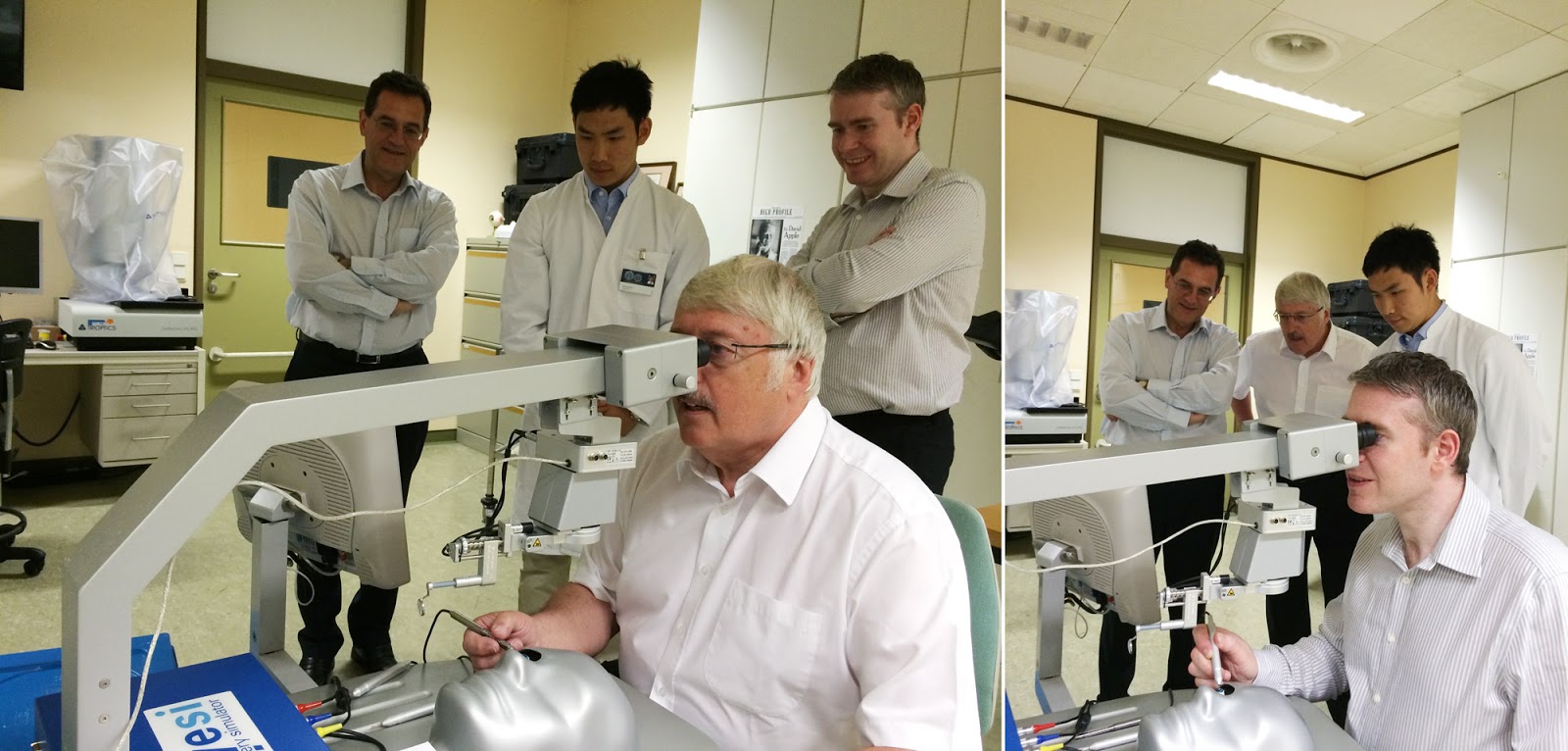
Training physicians and assistant personnel is an important part of the work in the laboratory. The Apple Lab offers workshops and continuing education for different subject areas in the form of internal and external events. IOL surgery can be replicated with a virtual-reality surgery simulator (Eyesi). In this way, routine surgeries and complex situations can be trained repeatedly – without risks for doctor or patient.
John McGregor and Dr. Richard Young on the virtual-reality surgery simulator (Eyesi)
This follows a long tradition, as over three decades Prof. Apple trained more than 200 students and doctors who visited his laboratory, and many of the “students” are now in senior positions in ophthalmic education and private practice. One of the “Apple Korps”, as Apple called them, is Gerd Auffarth, who in the 1990s he spent two years as a research fellow in Charleston learning from the pioneer in IOL pathology. Today Prof. Dr. med Gerd Auffarth is Chairman of the Eye Department at Heidelberg University and Head of the Apple Lab there.
When Prof. Apple died in 2011, his laboratory was located in Sullivan’s Island, South Carolina, but Gerd Auffarth sought permission from David Apple’s widow to perpetuate the Lab’s work at a more international level by re-locating it to Heidelberg. In the spring of 2012 the dream came true and the laboratory was shipped to Germany.
“Heidelberg is a most appropriate new location for the laboratory” Prof. Auffarth explains, “David admired the city and its university, and often visited here. Equal to his love of medical science, David revered the history of medicine. At over 600 years of age, our Medical Faculty is the oldest in Germany.“
Current Research on IOL design and materials
The Apple Lab provides an independent service to surgeons and industry, specializing in optical, physical, chemical and other analyses on ophthalmic devices.
During the developmental phase before a new device is tested in clinical trials, there are a number of physical and chemical measurements and tests, which can be conducted on the lens material to check its safety and efficacy. These activities are typically conducted by the polymer manufacturer and the IOL manufacturer, but Apple Lab conducts parallel measurements and tests to confirm and independently corroborate the manufacturer’s results.
The Apple Lab works hand-in-glove with Clinical Researchers at the University of Heidelberg and this is an ideal situation where a new lens design using a new material, is first tested in the Apple Lab and then in Clinical Research on Ethics Committee approved clinical trials on patients. Thus IOLs are studied at all stages of the product life-cycle and in many cases implants are examined before they are launched on the market, after which this is followed-up with vigilance studies on the device performance after it is marketed.
This post-market surveillance analysis continues the work that David Apple began 35 years ago. Explanted IOLs are sent to the laboratory to provide surgeons and IOL manufacturers with a report on the structural and ultrastructural analysis of the lens.
The explants are examined to identify changed morphology (lesions, inclusions, discolourations, etc.) and locate opacifications, whether these are in central, peripheral, superficial, cortical or pervasive positions, in or on the device. This produces a photographic record before the lenses go through Histological Staining and scanning electron microscopy (SEM) at different levels of magnification, and EDX (energy dispersive x-ray fluorescence) spectroscopy, all which helps to identify the chemical cause of an opacification.
In Heidelberg, Apple’s successors created a new database of IOL results, building on the studies conducted by him in the 1980s. The laboratory database has records of over 25,000 explanted IOL records and research IOLs – the number is growing rapidly.
But there is also new work being done in Heidelberg, as the Apple Lab has established links to centres of excellence in and around Heidelberg. Worth mentioning here is a unique collaboration with the University’s Applied Mathematics Department, where a joint research group aims to create mathematical models and simulations, to predict the efficacy and safety of IOLs over time.
“This is a new field, predicting the stability of IOL materials and designs many years after implantation” said Prof Auffarth. ”We are just at the beginning, but think about how important it would be if we could say that an IOL will keep its stability in the capsule over 5, 10, 15 years or more, or that an IOL biomaterial will be just as optically pure twenty years after implantation as the day it was implanted. It is especially important when you think of paediatric cataract extraction with IOL implantation. As a surgeon, I’m implanting a lens that should stay in the infant’s eye for many years – maybe for the rest of the child’s life“.
Contamac’s Simon Wyatt said “The Apple Lab brings together ophthalmic device manufacturers and ophthalmic surgeons from all over the world. Contamac is proudly sponsoring not only research on its own materials, but our contribution helped fund a research fellow from South Korea who worked in the lab last year and two research fellows from China who will work during 2016. The work they do typically confirms our own in-house results. But it is interesting when they spot a divergence from our results, as that can help us improve our material or we can make specific recommendations to IOL manufacturers on how the material should be handled during manufacture.”
For the 5th year in succession now, Contamac has continued to support global specialty lens education series by making generic basic and advanced courses available to practitioners and students in different parts of the world. The Contamac 2015 Education Series, provided by Eef van der Worp, optometrist, PhD, FAAO, FIACLE, FBCLA, FSLS, this year involved about 15 presentations including live lectures and a series of well-received live webinars, which provides specialty education to different optometry schools that may not normally have easy access to this type of education.
Looking at the list of topics presented (see below for the full playlist), in locations varying from Paris (France) to Bloemfontein (South Africa) and Cennai (India) – but also involving North-America (Portland OR USA and Montreal Canada), then it becomes clear that the future of soft lens fitting is one of the main topics of interest world-wide, although basic RGP lens topics, surely including the revived scleral lenses, are still very popular too. Basically everything involving specialty lens fitting is covered in this Contamac – World Wide Education Series – but the focus in this edition of Global Insight will be on new developments in the field of soft lens fitting.
Eye care practitioners have limited tools available to optimally fit, or choose, the first soft trial contact lens in clinical practice. To the surprise of some and the discontent of others, central keratometry values are not very useful in fitting soft lenses. In other words, there is a very weak correlation between the central K readings and the soft lens fit. In today’s contact lens practice, it may be more accurate to use the term “soft contact lens selection” rather than “soft contact lens fitting” as typically a certain lens is selected, almost at random, and placed on the eye to evaluate its behaviour in-vivo. In that regard, contact lens practitioners aim more at finding suitable eyes that fit the currently available stock lenses than at fitting a lens specifically to an individual eye it seems.
Understanding Soft Lens Design and Fitting: what are we actually fitting?
In an average contact lens practice, time and energy are invested in acquiring new lens wearers. But how much do we invest in our current lens wearers to give them the best available lenses today? Perhaps we can reverse the trend that is making soft lens fitting a lost art. Understanding ocular surface shape and elevation (height) data seems to be instrumental in the fitting process. This is why the first chapters of this book will be devoted to just that: understanding ocular surface shape, and in fact redefining they way we analyze the eye in contact lens practice. Quite literally: new terms including tangential shape of the peripheral cornea and anterior scleral area will be introduced, and microns of height as terminology instead of millimeters of curvature to describe the ocular surface shape. This will most probably become the new standard.
Understanding Ocular Surface Shape: the workbench
Measuring techniques, up to recently limited to central keratometry, have been upgraded:first to limbal-to-limbal corneal coverage topography instruments, and most recently to instruments that can measure the limbal area and beyond that – such as Scheimpflug systems, optical coherence tomography, and eye surface profilometry, thus helping us better understand the shape of the cornel-scleral junction and the anterior surface. Studies by Hall et al [8] have indicated that there is a direct relationship between corneo-scleral shape and soft lens fitting characteristics. Additionally, we have ways to better measure, analyse and understand the shape and geometry of currently used soft contact lenses.
A Game Changer
Interestingly, despite all material, replacement frequency and contact lens care developments in recent years, we are still facing high dropout rates. It may therefore be time to see whether we can do things differently. Potentially we may be off to a new beginning, changing or altering our approach in the way we that we fit and evaluate soft lenses going forward. This may be a game changer.
United
Working together – manufacturers, educators, researchers, eye care practitioners and professional organizations – we could all help elevate soft contact lens fitting to the next level. This, and new technologies, may enable us to improve our understanding of soft contact lens fitting, and change the contact lens practice of the future.
Comments
Sure Seale:
“The Skype lectures we had over the past 2 weeks were very informative and interesting. A greater understanding and perspective was created by the students regarding RGPs and sclerals. There was great appreciation for the comprehensive, clear (and somewhat entertaining) PowerPoint’s that were presented to us, we enjoyed listening to Eef van der Worp. The knowledge gathered in these sessions will be beneficial for our studies as well as in practice in the near future. Thank you Eef van der Worp.”
Carissa Cronje:
“It was such a big privilege to have class with Eef van der Worp. His enthusiasm of RGP’s is contagious and inspired us to be more open-minded on this specific topic. He gave us another perspective on the things we have already learnt and that adds depth and greater understanding to our knowledge. It also makes us aware that contact lenses are internationally used and that the development and improvement are ongoing. He is very humble and he keeps us interested during the lecture.”
Students from Bloemfontein, South Africa
Dr. Rajeswari Mahadevan, PhD, FIACLE, FSLS, FPROSE, FBCLA, EDHM, HOD – Contact lens clinic, Medical Research Foundation | Associate Professor – Elite School of Optometry | Director – Contact lens course from SN academy, Sankara Nethralaya:
“Dear Eef,EIVOC was a grand success with 1300 delegates attending the conference! Your lecture was well taken, and many were happy to see and hear you through Skype. I am thankful to you for the time and effort that you have taken to make this happen. Schools of optometry were so happy to have your book for their library. I am sure these lectures are going to impact the way practitioners handle scleral and soft lenses in future. Hope to see you at some conference soon. It will be great to have you here with us some time. Thank you so much once again.”
Dr. Matthew Lampa, OD, FAAO | Associate Professor | Chief of Contact Lens Services from Pacific University College of Optometry:
“On behalf of our students and the contact lens department at Pacific University I wanted to say thank you for your continued support of Dr. Eef van der Worp. At Pacific we have a contact lens elective in which the third year students are allowed to participate in (nearly the entire class enrolls and the only ones who do not, in my experience, are those that have clinic or laboratory conflicts). Within this course we cover a broad range of contact lens topics (most of which relate to specialty lenses) and Dr. van der Worp has participated for several years now and is a clear standout! His engaging and rich informational style resonates extremely well with the students as evidenced by the feedback we receive from them. He is seen as a world leading authority on so many specialty contact lens topics it is a real treat to be able to have that knowledge shared with out students and I believe makes a lasting impact in the way in which our students perceive, design and prescribe contact lenses in there practice while with us at Pacific and into their careers. Thank you again!”
Professor Langis Michaud, OD, M.Sc. FAAO (Dipl) | Fellow – British Contact Lens Association (FBCLA) | Fellow – Scleral Lens Education Soc. | Professor – Professeur titulaire at École d’optométrie de l’Université de Montréal:
“Dear Eef,Thanks for your contribution. Great as habitual. Very well received from our side… . Plan to do the same next year – no question.”
Skype Webinar ‘live’ @ École d’optométrie de l’Université de Montréal
Soft Special Edition Newsletter
Also in line with Contamac’s World Wide Education series, since 5 years Contamac continues to be the sole sponsor of Soft Special Edition, a quarterly newsletter on soft specialty contact lens research, developments, designs and materials. Currently the newsletter is gearing up for its 23th publication (www.softspecialedition.com). All previous editions can be viewed through the ‘archives’ link on the website. Readers from all over the world have subscribed to this new educational newsletter, which is available free of charge to any eye care practitioners and is kindly supported by Contamac Ltd. To sign up, simply visit the Soft Special Edition website.
The 2015 publications included the contributions of renowned world leaders in the field of contact lens research and education, including:
Contact Lens Dewetting: Assessment of Lens Biocompatibility with the Tear Film Dorota H. Szczesna-Iskander PhD Wroclaw University of Technology, Wroclaw (Poland)
Myopia control with soft contact lenses, what is possible? Percy Lazon de la Jara PhD, BOptom FIACLE FAAO Head of Clinical Research, Brien Holden Vision Institute, Sydney (AU)
Customized soft lenses based on sagittal height segments Mario Rohnert Product engineering and Project Management at Hecht Contactlinsen GmbH (Freiburg, Germany)
Ocular topography and soft contact lens fit Lee Hall BSc (Hons) PhD FBCLA Investigator at Visioncare Research and Visiting Research Fellow at Aston University (UK)
The Contamac World Wide Educational Series 2015
Elevating the Art of Soft Lens Fitting – Congress d’Optométrie et de Contactologie
January 18–19
Paris (FR)
The Learning Curve: using height in CL practice, OVN congres
February 8–9
Den Bosch (NL)
Soft Lens Fitting: the potential benefits of using SAGs – CLSS
March 13–15
Billund (DK)
Corneal Topography, Improving RGP lens fitting (Live web lecture)
April 8
Bloemfontein (SA)
Fitting the irregular cornea & scleral lens fitting (Live web lecture)
April 15
Bloemfontein (SA)
The Lost Art of Soft CL Fitting – EFCLIN
May 7–10
Venice (IT)
Using SAG height to improve soft lens fitting – EFCLIN
May 7–10
Venice (IT)
The Future of Soft Lens Fitting Starts Here (Live web lecture)
May 13
Bloemfontein (SA)
Elevation – And The Lost Art of Soft Lens Fitting – EIVOC
August 14
Cennai (India)
Beyond the Corneal Borders – The future of fitting the irregular cornea?
August 15
Cennai (India)
The Lost Art of Soft Lens Fitting – University of Minho
September 16+17
Braga (PT)
The Future of Soft Lens Fitting – ECLSO
October 16–19
Izmir (TU)
Scleral Lens Fitting Update – ECLSO
October 16–19
Izmir (TU)
New Technology in Contact Lens Practice (Live weblecture) – Pacific University
November 9
Forest Grove (USA)
New Technology in Contact Lens Practice (Live web lecture) – University of Montreal
Perfect vision without spectacles, contacts or laser correction seems too good to be true, but it is the reality for many patients requiring vision correction, whose practitioners have introduced them to Orthokeratology (Ortho-k). Working along the same principles as orthodontics, the procedure involves wearing a specially designed pair of gas permeable lenses overnight and removing them upon awakening. The lenses gently mould the cornea (front surface of the eye) into the correct shape required to provide the wearer with perfect vision during the day, without any other correction. The effect is temporary and so the lenses need to be worn each night, but it means that it is totally reversible and so if the patient decides to cease using Ortho-k or decides to go for laser surgery at a later date, the cornea will return to normal within a very short period of time.
Ortho-K lens on eye with Fluorescent dye to show fitting.
Another intriguing benefit for younger short-sighted patients is the fact that Ortho-k appears to slow down the progression of myopia (short-sightedness). This is particularly important for practitioners around the world at the present time, because the world is facing what has been called a “myopia epidemic”. More and more children in developed and developing countries are becoming short-sighted and practitioners are desperate to find a remedy for the progression of the condition that can cause significant problems in later life. To date, Ortho-k is providing better results than any other method currently under investigation.
Because of this, the average age of wearers that these lenses are fitted to, is just 12 years.
At the other end of the scale, older contact lens wearers whose eyes are becoming dry and lenses become uncomfortable towards the end of the day’s wear, are finding that they can see all day in comfort by switching to this modality. Even bifocal and multifocal designs are available for those patients who need additional help with reading.
Ortho-k works best for short-sightedness with limited amounts of astigmatism. Some fitters are achieving limited success with long-sighted patients, but in the main prescriptions between -1.00 and -5.00 with astigmatism up to -1.50 can be fitted fairly routinely.
At present only specialist practitioners are supplying these lenses, but a local search should provide details of a practitioner near you.
The summer seems to have come and gone in a flash, but I hope you all managed some time to relax and enjoy the sunshine.
Here at Contamac the summer has seen us complete our move to Shire Hill, which given the potential difficulties, went incredibly smoothly. Our new facility has allowed us to plan a more efficient production flow, and finally some much needed space to better resource our growing R&D. With the improved capacity and facilities, we have added four additional members to our R&D team. In addition to projects in contact lens materials, we are now also moving ahead with two new IOL material developments, a next generation hydrophobic, aimed at addressing the key “complaints” of glistening and larger incision size, and a hydrophilic material with some unique properties. Further information will follow as the projects progress.
The end of summer was quickly followed by a very busy and well attended ESCRS in the beautiful city of Barcelona. I was delighted to see many old friends, as well as meet new colleagues from our industry. The “holy grail” of a truly accommodating IOL seemed a regular topic of conversation, and over the past 6 months we have seen a number of interesting designs emerging. Whilst some of these may work in theory, the challenge of manufacturing often complex designs on a commercial basis, with the added challenge of combining different materials, will considerably test existing manufacturing skills. We shall wait and see.
Manufacturers do appear to be overcoming the historical challenge of making a hydrophobic IOL, and many now have such IOLs in their product portfolio. Our HI56 semi-finished hydrophobic material is now available in clear material with a power range of 10-30d, in 0.5d increments. Having the optic fully moulded removes the most difficult aspect of producing a hydrophobic IOL, machining a high quality optic on a consistent basis. The benefits of a moulded optic are high quality, reproducibility, and polish free, leaving the square edge exactly as it should be: square. Our material has a full set of biocompatibility documentation in addition to a Clinical Evaluation, saving the manufacturer time and considerable cost in obtaining the required approvals. A yellow version will be available in early 2016.
With more hydrophobic IOLs, there appears to be a greater demand for pre-loaded delivery systems. Over the past years, there has been much research and investment in this area, and I remain to be convinced the challenges have been completely overcome. Delivery systems are a crucial part of successful cataract surgery. Any surgeon will tell you the key requirements are safe and reliable delivery with no damage to the lens. And yet, with ever growing pressure on pricing globally, and injectors often “given away” with the IOL, there is a natural temptation to make savings on lower quality delivery systems. A dangerous precedent, since where injectors are provided with the lens the two may be judged together!
I am delighted to announce that Contamac has secured the exclusive global distribution rights to a new European manufactured delivery system, the ErgoTouch. As the name suggest, the ergonomic design provides comfortable use for the surgeon, giving a precise, controlled and safe delivery of the lens.
Injector and Cartridge
The ErgoTouch delivery system has a new feature to help support the surgeon as well as OR personnel:
Large finger contact for comfort of use.
Plunger with stopper for a safe stop/start.
The plunger is designed with advanced material for perfect alignment and robustness.
The injector body is made of crystal clear material, with large fenestration, on both sides, for improved visibility of the delivery process.
The injector body is designed for better handling, and for a “two hands” injection procedure.
Soft-touch texture for safe and comfortable handling
Anti-slippery texture for safety
Rounded cartridge corner to maintain safety
The delivery system is supplied in two versions, the ErgoTouch and the ErgoTouch Plus.
The ErgoTouch cartridge utilizes a gliding agent, GMS, with low surface migration and well controlled moulding condition to prevent significant transfer residue. Disposable cartridges are available in a range of incision sizes from 1.8mm to 2.6mm depending on the surgical technique used.
The ErgoTouch Plus cartridge utilizes a coating treatment technology which protects the IOL from damage during cataract surgery, with no additive transfer on the lens post-delivery. Disposable Plus cartridges are available in a range of incision sizes from 1.8mm to 2.6mm depending on the surgical technique used.
The ErgoTouch and ErgoTouch Plus are now available in “bulk”, and will have CE mark by mid-2016.
My next trip is to China, where between customer visits, I hope to learn more about the recent changes to the registration requirements which are causing some alarm.
I then head to the AAO in Las Vegas where I hope to see many of you again.
On 16th October the Lord-Lieutenant of Essex, Baron John Petre, unveiled a plaque to mark the official opening of Contamac’s new facility in Saffron Walden.
He was accompanied by distinguished guests including Sir Alan Haselhurst MP, Cllr Heather Asker and Cllr Stephanie Harris.
Her Majesty’s Lord-Lieutenants are the representatives of the Crown for each county of the United Kingdom. They were originally appointed in the reign of Henry VIII to take over the military duties of the Sheriff and control the military forces of the Crown. These days they are responsible for organising Royal visits to their county as well as other duties that include the presentation of decorations where the recipient is unable to attend an Investiture. These include the Queens Awards amongst others.
During his address to the 75 members of staff and guests, Lord Petre congratulated the company’s management and staff on the continued growth of the company since Contamac was presented with the Queens Award for Enterprise in 2012.
Both Lord Petre and guests then enjoyed a tour of the 36,000 sq. ft. facility before joining members of staff for an informal lunch at the company’s new headquarters.
Chairman John McGregor thanked management, staff and contractors for their support during the transition and said, ”The new facility represents a multi-million pound investment in state of the art manufacturing and research equipment and includes an ISO 10,000 clean room.
Since moving to the new facility the company has experienced record sales and is now ideally placed to cope with the anticipated growth in demand for Contamac’s current products and planned future developments”.
Contamac has already recruited 15 new members of staff as a result of the move. In particular a 25% increase in Research and Development, which the company sees as key to future growth. The new facility will also allow for production to grow by 50% and come at an ideal time for Contamac to keep pace with current industry trends.